Aller au contenu principal

Formules de Taylor

Étudier une fonction ff peut être "difficile". L'idée des formules de Taylor est d'approximer une fonction ff avec des fonctions polynomiales. Si ff est assez régulière en un point, on pourra le faire localement. Pour formaliser l'idée, on peut définir la notion suivante.

Définition 5.1. Soit II un intervalle (ouvert) de R\mathbb{R}, x0∈Ix_0 \in I et f:I→RNf : I \to \mathbb{R}^N qui est dérivable nn fois en x0x_0. Alors le polynôme de ff de degré nn autour de x0x_0 est

Pf,n,x0=∑k=0nf(k)(x0)k!(x−x0)kP_{f, n, x_0} = \sum_{k=0}^{n} \frac{f^{(k)}(x_0)}{k!} (x - x_0)^k

Par exemple, Pf,0,x0=f(x0)P_{f, 0, x_0} = f(x_0) ; si ff est dérivable une fois

Pf,1,x0=f(x0)+f′(x0)(x−x0)P_{f, 1, x_0} = f(x_0) + f'(x_0)(x - x_0)

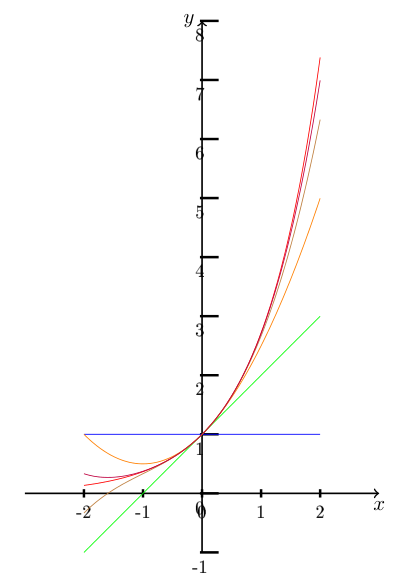
Exemple 5.1 (Graphique). Soit f(x)=exf(x) = e^x. Représenter le graphe de ff, de Pf,0,0P_{f, 0, 0}, Pf,1,0P_{f, 1, 0}, Pf,2,0P_{f, 2, 0} (ils existent parce que ff est dérivable un nombre infini de fois en x0x_0). P0=1P_0 = 1, P1=1+xP_1 = 1 + x, P2=1+x+x22P_2 = 1 + x + \dfrac{x^2}{2}.

Graphe de l'exponentielle et de ses polynômes de Taylor successifs en 0 sur [-2, 2]

Théorème 5.1 (Polynôme de Taylor avec reste intégral). Soit II un intervalle ouvert de R\mathbb{R}, x0∈Ix_0 \in I et f:I→Rnf : I \to \mathbb{R}^n une fonction de classe Cn\mathcal{C}^n sur II et de classe Cn+1\mathcal{C}^{n+1} par morceaux sur II, pour n∈Nn \in \mathbb{N}. Alors

f(x)−Pf,n,x0(x)=∫x0x(x−t)nn!f~(n+1)(t) dt∀x∈If(x) - P_{f, n, x_0}(x) = \int_{x_0}^{x} \frac{(x - t)^n}{n!} \tilde{f}^{(n+1)}(t)\,dt \quad \forall x \in I

Démonstration. Par récurrence sur nn.

  • Pour n=0n = 0 : la fonction ff est continue et de classe C1\mathcal{C}^1 par morceaux sur II

    f(x)−Pf,0,x0(x)=f(x)−f(x0)=∫x0xf~′(t) dtf(x) - P_{f, 0, x_0}(x) = f(x) - f(x_0) = \int_{x_0}^{x} \tilde{f}'(t)\,dt
  • Supposons la propriété vraie pour tout k≤nk \leq n et prouvons-la pour n+1n + 1. Soit alors ff une fonction de classe Cn+1\mathcal{C}^{n+1} sur II et de classe Cn+2\mathcal{C}^{n+2} par morceaux sur II. Alors

    f(x)−Pf,n+1,x0(x)=f(x)−∑k=0n+1f(k)(x0)k!(x−x0)k=f(x)−(∑k=0nf(k)(x0)k!(x−x0)k+f(n+1)(x0)(n+1)!(x−x0)n+1)=f(x)−Pf,n,x0(x)−f(n+1)(x0)(n+1)!(x−x0)n+1=∫x0x(x−t)nn!f~(n+1)(t) dt−f(n+1)(x0)(n+1)!(x−x0)n+1\begin{aligned} f(x) - P_{f, n+1, x_0}(x) &= f(x) - \sum_{k=0}^{n+1} \frac{f^{(k)}(x_0)}{k!} (x - x_0)^k \\ &= f(x) - \left(\sum_{k=0}^{n} \frac{f^{(k)}(x_0)}{k!} (x - x_0)^k + \frac{f^{(n+1)}(x_0)}{(n + 1)!} (x - x_0)^{n+1}\right) \\ &= f(x) - P_{f, n, x_0}(x) - \frac{f^{(n+1)}(x_0)}{(n + 1)!} (x - x_0)^{n+1} \\ &= \int_{x_0}^{x} \frac{(x - t)^n}{n!} \tilde{f}^{(n+1)}(t)\,dt - \frac{f^{(n+1)}(x_0)}{(n + 1)!} (x - x_0)^{n+1} \end{aligned}

    La dernière égalité est obtenue par hypothèse de récurrence (ff est de classe Cn+1\mathcal{C}^{n+1} sur II, donc de classe Cn\mathcal{C}^n sur II et de classe Cn+1\mathcal{C}^{n+1} par morceaux sur II). On remarque que f~(n+1)=f(n+1)\tilde{f}^{(n+1)} = f^{(n+1)} car f∈Cn+1(I,Rn)f \in \mathcal{C}^{n+1}(I, \mathbb{R}^n), et ff est Cn+2\mathcal{C}^{n+2} par morceaux, donc f(n+1)f^{(n+1)} est continue et de classe C1\mathcal{C}^1 par morceaux sur II. La formule d'intégration par parties nous donne alors

    f(x)−Pf,n+1,x0(x)=∫x0x(x−t)nn!f(n+1)(t) dt−f(n+1)(x0)(n+1)!(x−x0)n+1=[−(x−t)n+1(n+1)!f(n+1)(t)]x0x−∫x0x−(x−t)n+1(n+1)!f~(n+2)(t) dt−f(n+1)(x0)(n+1)!(x−x0)n+1=(x−x0)n+1(n+1)!f(n+1)(x0)+∫x0x(x−t)n+1(n+1)!f~(n+2)(t) dt−(x−x0)n+1(n+1)!f(n+1)(x0)=∫x0x(x−t)n+1(n+1)!f~(n+2)(t) dt\begin{aligned} f(x) - P_{f, n+1, x_0}(x) &= \int_{x_0}^{x} \frac{(x - t)^n}{n!} f^{(n+1)}(t)\,dt - \frac{f^{(n+1)}(x_0)}{(n + 1)!} (x - x_0)^{n+1} \\ &= \left[-\frac{(x - t)^{n+1}}{(n + 1)!} f^{(n+1)}(t)\right]_{x_0}^{x} - \int_{x_0}^{x} -\frac{(x - t)^{n+1}}{(n + 1)!} \tilde{f}^{(n+2)}(t)\,dt - \frac{f^{(n+1)}(x_0)}{(n + 1)!} (x - x_0)^{n+1} \\ &= \frac{(x - x_0)^{n+1}}{(n + 1)!} f^{(n+1)}(x_0) + \int_{x_0}^{x} \frac{(x - t)^{n+1}}{(n + 1)!} \tilde{f}^{(n+2)}(t)\,dt - \frac{(x - x_0)^{n+1}}{(n + 1)!} f^{(n+1)}(x_0) \\ &= \int_{x_0}^{x} \frac{(x - t)^{n+1}}{(n + 1)!} \tilde{f}^{(n+2)}(t)\,dt \end{aligned}

Théorème 5.2 (Inégalité de Taylor-Lagrange). Soit II un intervalle ouvert, x0∈Ix_0 \in I et f:I→RNf : I \to \mathbb{R}^N de classe Cn\mathcal{C}^n sur II et de classe Cn+1\mathcal{C}^{n+1} par morceaux sur II. Alors il existe c>0c > 0 tel que ∥f~(n+1)(x)∥<c ∀x∈[a,b]\|\tilde{f}^{(n+1)}(x)\| < c \ \forall x \in [a, b], avec x0∈[a,b]x_0 \in [a, b], et

∥f(x)−Pf,n,x0(x)∥≤∣x−x0∣n+1(n+1)!cx∈[a,b]\|f(x) - P_{f, n, x_0}(x)\| \leq \frac{|x - x_0|^{n+1}}{(n + 1)!} c \qquad x \in [a, b]

(pour n'importe quel choix de norme ∥.∥\|.\| sur Rn\mathbb{R}^n)

Démonstration. Comme f∈CMn+1(I,Rn)f \in \mathcal{CM}^{n+1}(I, \mathbb{R}^n), alors f(n+1)f^{(n+1)} est une fonction continue par morceaux sur [a,b][a, b], donc f~(n+1)\tilde{f}^{(n+1)} est bornée sur [a,b][a, b] ; alors ∃c>0\exists c > 0 tel que ∥f~(n+1)(x)∥≤c ∀x∈[a,b]\|\tilde{f}^{(n+1)}(x)\| \leq c \ \forall x \in [a, b]. Supposons d'abord que x∈[a,b]x \in [a, b] est tel que x0≥xx_0 \geq x ; grâce au théorème 5.1 :

∥f(x)−Pf,n,x0(x)∥=∥−∫xx0(x−t)nn!f~(n+1)(t) dt∥≤∫xx0∥(x−t)nn!f~(n+1)(t)∥dt=∫xx0∣x−t∣nn!∥f~(n+1)(t)∥ dt≤∫xx0(t−x)nn!c dt=c∫xx0(t−x)nn! dt=c[(t−x)n+1(n+1)!]xx0=c(x0−x)n+1(n+1)!=c∣x−x0∣n+1(n+1)!\begin{aligned} \|f(x) - P_{f, n, x_0}(x)\| &= \left\|-\int_x^{x_0} \frac{(x - t)^n}{n!} \tilde{f}^{(n+1)}(t)\,dt\right\| \\ &\leq \int_x^{x_0} \left\|\frac{(x - t)^n}{n!} \tilde{f}^{(n+1)}(t)\right\| dt \\ &= \int_x^{x_0} \frac{|x - t|^n}{n!} \|\tilde{f}^{(n+1)}(t)\|\,dt \\ &\leq \int_x^{x_0} \frac{(t - x)^n}{n!} c\,dt \\ &= c \int_x^{x_0} \frac{(t - x)^n}{n!}\,dt \\ &= c \left[\frac{(t - x)^{n+1}}{(n + 1)!}\right]_x^{x_0} \\ &= c \frac{(x_0 - x)^{n+1}}{(n + 1)!} \\ &= c \frac{|x - x_0|^{n+1}}{(n + 1)!} \end{aligned}

Corollaire 5.1 (cas particulier du théorème de Taylor-Young). Soit II un intervalle (ouvert) réel, f:I→RNf : I \to \mathbb{R}^N une fonction de classe Cn\mathcal{C}^n sur II et de classe Cn+1\mathcal{C}^{n+1} par morceaux sur II ; alors f(x)=Pf,n,x0(x)+(x−x0)n⋅ϵ(x)f(x) = P_{f, n, x_0}(x) + (x - x_0)^n \cdot \epsilon(x) avec lim⁡x→x0ϵ(x)=0\displaystyle\lim_{x \to x_0} \epsilon(x) = 0 (c'est-à-dire lim⁡x→x0∥ϵ(x)∥=0\displaystyle\lim_{x \to x_0} \|\epsilon(x)\| = 0).

Démonstration. Il suffit d'écrire ϵ(x)={f(x)−Pf,n,x0(x)(x−x0)nsi x≠x00\epsilon(x) = \begin{cases} \dfrac{f(x) - P_{f, n, x_0}(x)}{(x - x_0)^n} & \text{si } x \neq x_0 \\ 0 \end{cases}. On a que

lim⁡x→x0∥ϵ(x)∥=lim⁡x→x01∣x−x0∣n∥f(x)−Pf,n,x0(x)∥≤lim⁡x→x0c(n+1)!∣x−x0∣n+11∣x−x0∣n\lim_{x \to x_0} \|\epsilon(x)\| = \lim_{x \to x_0} \frac{1}{|x - x_0|^n} \|f(x) - P_{f, n, x_0}(x)\| \leq \lim_{x \to x_0} \frac{c}{(n + 1)!} |x - x_0|^{n+1} \frac{1}{|x - x_0|^n}

Remarque 5.1. Ce corollaire justifie formellement l'intuition que Pf,n,x0P_{f, n, x_0} est une bonne approximation de ff autour de x0x_0. On écrit aussi que f(x)−Pf,n,x0(x)f(x) - P_{f, n, x_0}(x) est o(∣x−x0∣n)o(|x - x_0|^n) ou O(∣x−x0∣n+1)O(|x - x_0|^{n+1}).

Remarque 5.2. Les hypothèses du corollaire ne sont pas les moins fortes possibles (théorème de Taylor-Young).